Addressing a Failing or Faulty Pump

basaltfeatureThere are many reasons your pump may be working poorly or not at all. Let’s help you to troubleshoot your problem.

There’s a chance that your pump isn’t getting any power. Check the circuit breaker and GFCI outlet to make sure neither of them have tripped. You can test the electrical source by plugging the pump into a different outlet. If necessary, you can take the pump out of pond to do this. Just make sure you don’t run the pump dry for more than a few seconds.

Check to make sure that your hoses are free from any kinks and blockages. Be sure to check every inch.

If your model pump allows it, remove the filter screen and clean and inspect the impeller. It should be free of any debris. If you have a skimmer or filter it is imperative that you keep these clean. The dirtier they are the harder your pump has to work. It’s a good idea to put your maintenance schedule on a calendar in order to keep things running properly.

It’s important that your pump has the correct flow rate . You will want your flow rate to be at least half the volume of the whole pond and this is a minimum required flow rate for proper water flow. Follow the manufacturer recommendations for your pump’s water flow rate depending on the amount of water it is going to be used for. Need to calculate the gallonage of your pond? See this page from our last newsletter.

Remember to always isolate the power before maintenance to avoid electric shock. You should read manufacturer’s instructions for individual pumps requirements.

There are no two ways about it, eventually pumps fail. It’s not uncommon for a pump to burn out every few years, but if you are consistent with maintenance you will be sure to extend its life.

Share

Pest Deterents

Raccoons and herons can be very troublesome to fish keepers. We offer a number of products to keep unwanted visitors away from the pond.

scarecrowThe ScareCrow® motion-activated sprinkler automatically detects deer, racoons, heron, dogs and more as they approach, and repels them with a short but startling burst of water. The sudden noise, movement and spray scares animals away, teaching them to avoid the area in future.It works day and night without chemicals or unsightly barriers and operates up to six months on a single 9 volt battery. We offer the ScareCrow for $89. trap

The Advantek 2 pack of galvanized live animal traps features two sizes of live animal traps in a single pack. Catch & release traps are a humane and efficient means of relocating unwanted and troublesome animals. Just $50!

fidoshockThe Fido Shock fence system installs easily by enclosing the area you wish to protect with a single strand of non-insulated wire which is affixed to but insulated from short posts around the area. Drive a grounding rod into the ground, connect the fence wire and grounding rod to the fence charger, plug it in, and your area is protected from pets and other animals. The Fido Shock system works by administering a memorable, but safe electric shock to any animal touching the boundary wire. We have the system at Falling Water Gardens for $74.

raccoon1heron

Share

Heat Up Your Garden

One of my favorite new items for the garden is outdoor heaters. Outdoor heaters allow you to spend more time in the garden by providing a bit of heat in the early spring and on cool summer nights. Heaters allow you to extend your stay in the garden instead of moving into the house.
heater

By now most people are familiar with the “umbrella” type propane heaters that are widely available and reasonably priced. These types of heaters have the advantage of being portable and you can drag them from one part of your patio or garden to another. They do have several drawbacks however. One is that they seem to always run out of propane right in the middle of your dinner party, and you have to bring the propane tank somewhere to exchange or fill it. Another draw back is that they work by combustion. The propane is burned creating heat which is then reflected down at you by the umbrella type reflector at the top of the heater. This reflected exhaust can be blown away by a brisk wind so that you don’t get warm or feel the heat. Finally, the fact that they burn propane and create heat through combustion means that you must be careful to not catch anything on fire when you’re using this type of heater.

A relatively new type of heater on the market is the infrared radiant energy heater. Infratech manufactures one that I really like.

The Infratube Heater incorporates a specially designed electric quartz heating element that produces safe infrared radiant energy. Radiant energy is only absorbed by solid objects and is not wasted heating the air. In addition, Infratube Heaters emit no harmful ultraviolet rays. Since there are no open flames or carbon monoxide emissions, mountings clearance requirements are minimal.

infratech-heater-onlyInfratube heaters can be installed at lower mounting heights, under canvas, wood awnings, eves and in interior locations.

Infratube Heaters turn cold indoor and outdoor areas into comfortable inviting spaces. Infratube Heaters are easily and permanently mounted out of reach of children and pets. Simply flip on the switch and reach desired heat with 90 seconds. Electric infrared heaters are remarkably efficient and cost effective. Over 90% of the input energy is converted directly to radiant heat. In ratube heaters focus that energy with pinpoint accuracy to the target area. Typical operating costs is less than $0.30 per hour based on $0.10 per KW

The benefits to this type of heater are that they run on electricity so you don’t have to continually refill a propane tank. As well, they don’t heat the air with exhaust, they heat objects with radiant energy so the wind can’t blow the heat away before it gets to you. Finally, they are very affordable and comparable in price to the propane umbrella heaters.

Share

Cleaning Your Skimmer

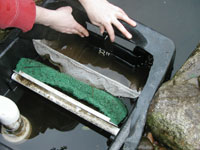
Today’s ponds are very low maintenance because of modern innovations such as up-flow filters and skimmers. Pond maintenance only takes a few minutes periodically, but ponds are not maintenance free. One of the most common problems with ponds is that the homeowner doesn’t properly clean the skimmer and eventually plant material gets behind the skimmer pad into the area where the pump is kept. The number one failure of pumps is caused by material gathering around the pump intake, restricting the flow of water and causing the pump to over heat and eventually fail. Look over the following pictures that show how to properly clean out a skimmer box.

The net should be emptied whenever it is full of debris. In the summer that isn’t very often, but in the fall it could be every few days as falling leaves build up in the net.

The skimmer pad should be cleaned anytime you notice that the water level in front of the pad is higher than the water behind the pad. A clean pad will have equal levels of water on both sides. As the pad clogs with tree needles and the like, it is harder for the water to flow through and you will notice the water on the back side is lower. When that happens follow the instructions below.

Turn off pump and close skimmer door

Turn off pump and close skimmer door.

Unscrew the pvc union, remove the pump.

Unscrew the pvc union, remove the pump.

Remove the filter matting.

Remove the filter matting.

Remove filter matting tray.

Remove filter matting tray.

Clean filter matting with hose.

Clean filter matting with hose.

Clean both sides of matting.

Clean both sides of matting.

Empty skimmer net and wash.

Empty skimmer net and wash.

Clean with wet/dry vacuum.

Clean with wet/dry vacuum.

Reinstall tray matting and net.

Reinstall tray matting and net.

Open door, turn system on.

Open door, turn system on.

Share